Accessories
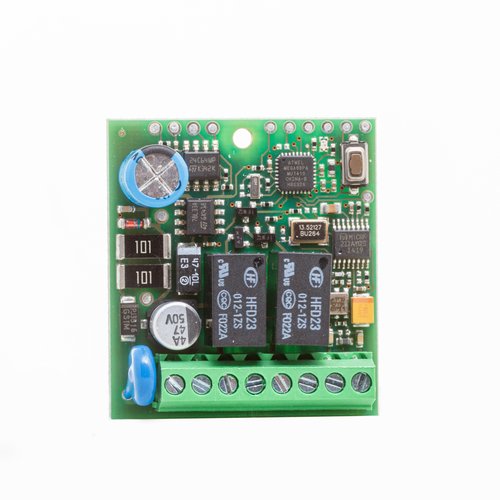
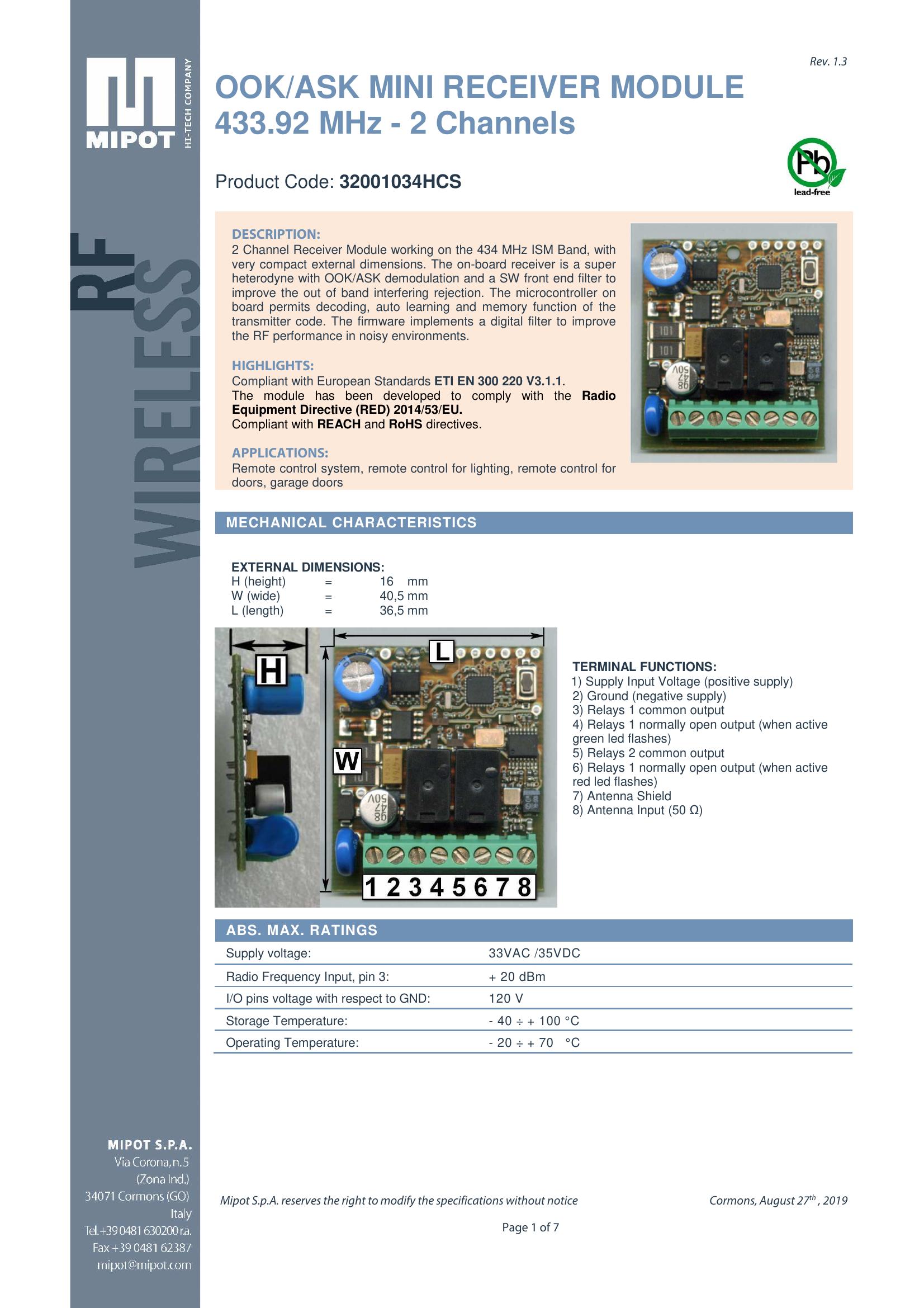
32001034HCS
2 Channel Receiver Module working on the 433,92 MHz ISM Band, with very compact external dimensions.
Highlights
- Frequency: 434 MHz
- Voltage Supply: 12V - 24V
- Modulation: ASK
- Type: Receiver

The on-board receiver is a super heterodyne with OOK/ASK demodulation and a SW front end filter to improve the out of band interfering rejection.
The microcontroller on board permits decoding, auto learning and memory function of the transmitter code.
The firmware implements a digital filter to improve the RF performance in noisy environments.
Compliant with European Standards ETI EN 300 220 V3.1.1.
The module has been developed to comply with the Radio Equipment Directive (RED) 2014/53/EU.
Compliant with REACH and RoHS directives.
Applications
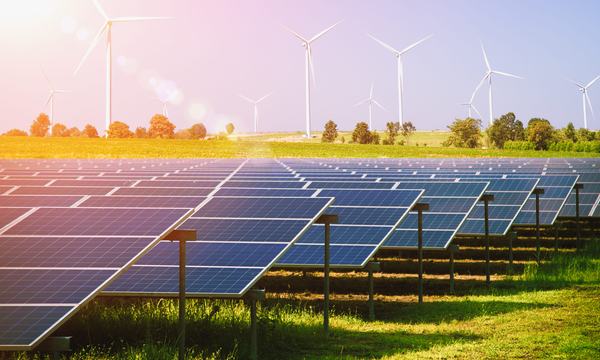
Smart Renewable Energy System
A smart energy management system (SEMS) enables the effective utilization of available energy resources and thus results in energy-efficient operation of a smart grid
Smart grid technology is enabling the effective management and distribution of renewable energy sources such as solar, wind, and hydrogen.
The smart grid connects a variety of distributed energy resource assets to the power grid.
By leveraging the Internet of Things (IoT) to collect data on the smart grid, utilities are able to quickly detect and resolve service issues through continuous self-assessments. Because utilities no longer have to depend on customers to report outages, this self-healing capability is vital component of the smart grid.

Building Management (Smart Building - Home Automation - Smart Home)
Smart cities aren’t just a concept or a dream of the future. Thanks to the wildly innovative Internet of Things (IoT) solutions, many are already active and expanding rapidly. Municipal governments are leveraging cellular and Low Power Wide Area (LPWAN) wireless technologies to connect and improve infrastructure, efficiency, convenience, and quality of life for residents and visitors alike.
Communities can improve energy distribution, streamline trash collection, decrease traffic congestion, and improve air quality with help from the IoT.
- Smart Infrastructure
- Air Quality Management
- Traffic Management
- Smart Parking
- Smart Waste Management
The first building block of any smart city application is reliable, pervasive wireless connectivity.
While there’s no one-size-fits-all, evolving Low Power Wide Area Network (LPWAN) technologies are well suited to most smart city applications for their cost efficiency and ubiquity.
Smart Lighting
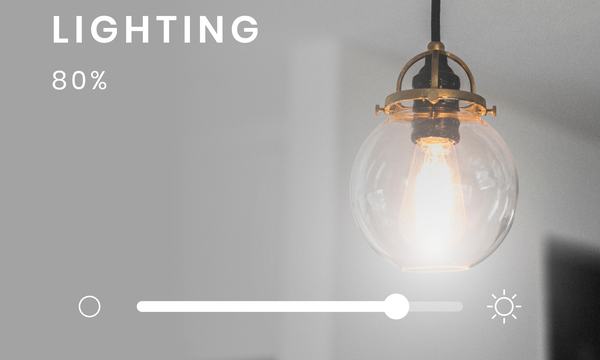
The concept of Smart Lighting refers to all those Smart lighting systems that are able to operate in a more flexible, customisable and efficient manner than traditional wired and manual systems.
These are a series of technological solutions such as bulbs, switches and other devices that can create usage scenarios according to a specific context, or that can be controlled remotely at any time. This results in a more efficient and scalable lighting system that can be adapted to the needs of the environment in which it is installed, as well as lowering energy consumption and the environmental impact associated with it.
When smart lighting integrates with the IoT, all interconnected devices can be controlled remotely. This means that lights can be switched on, off or programmed to come on even when you are not physically present in the room, but not only that, you can manage their intensity, colour and set more energy-efficient lighting scenarios.