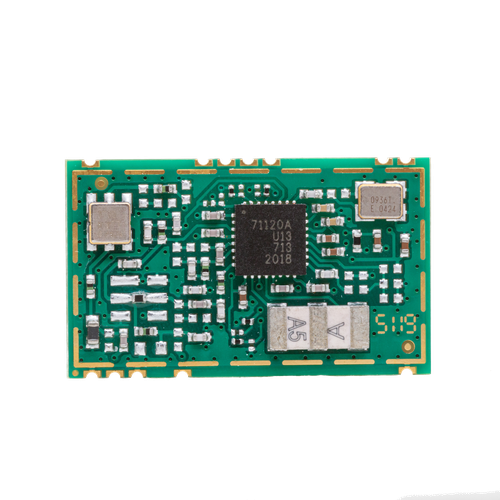
Wireless Transparent Modules
32001368F
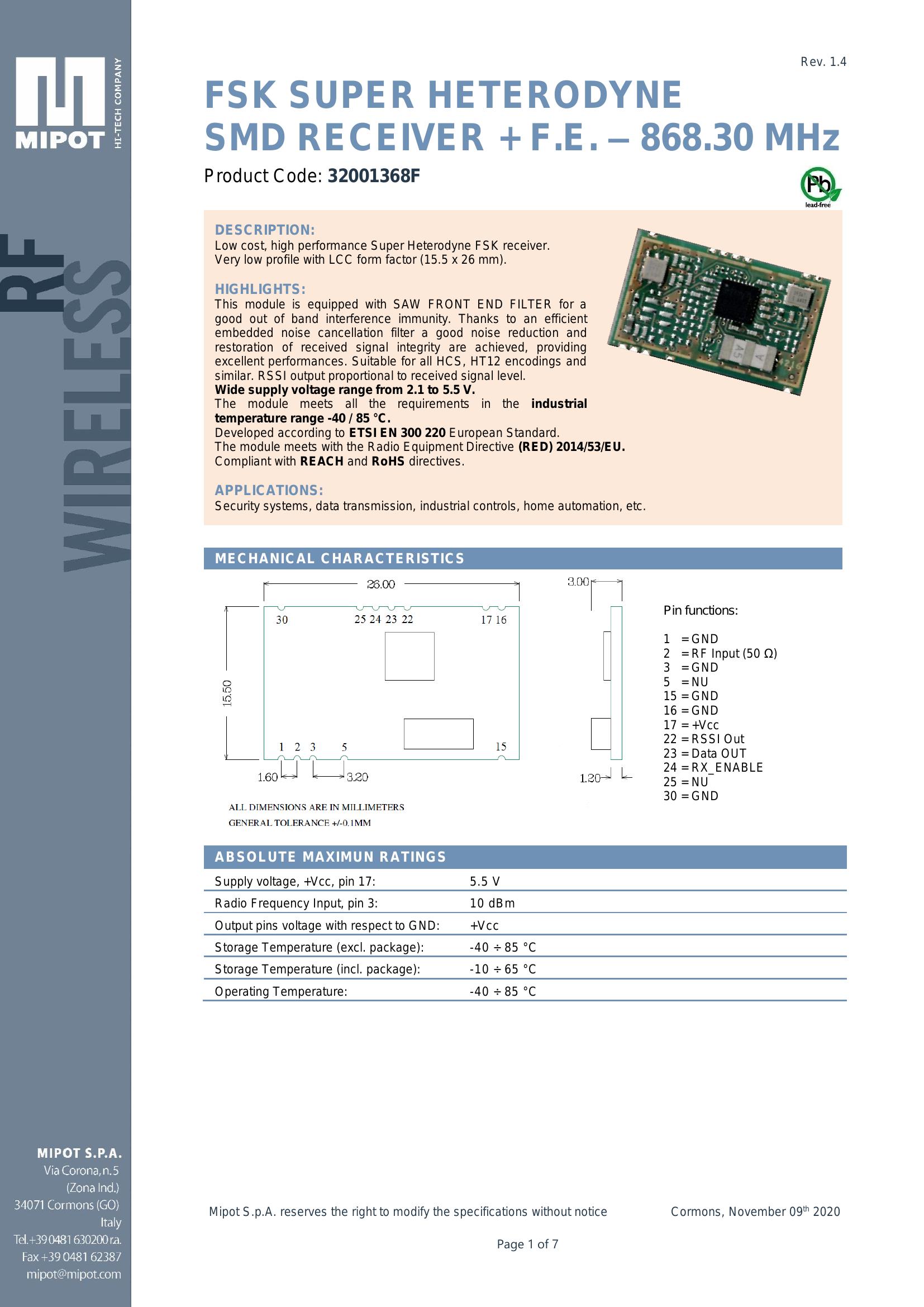
Low cost, high performance Super Heterodyne OOK/ASK receiver. Very low profile with LCC form factor (15.5 x 26 mm). This module is equipped with SAW FRONT END FILTER for a good out of band interference immunity. Thanks to an efficient embedded noise cancellation filter, you get a good noise reduction and restoration of received signal integrity, providing excellent performances. Suitable for all HCS, HT12 encodings and similar.
Highlights
- Frequency: 868 MHz
- Voltage Supply: 3-5 V
- Modulation: FSK
- Sensitivity: -102 dBm
- Form Factor: SMD
- Dimensions: 15.5x26x3 mm

RSSI output proportional to received signal level.
Wide supply voltage range from 2.1 to 5.5 volt.
Industrial temperature range from -40 to +85°C.
Developed in compliance with ETSI EN 300 220 V. 3.1.1 European Standard.
The module has been developed to comply with the Radio Equipment Directive (RED) 2014/53/EU.
Compliant with REACH and RoHS directives.

Applications

Building Management (Smart Building - Home Automation - Smart Home)
Smart cities aren’t just a concept or a dream of the future. Thanks to the wildly innovative Internet of Things (IoT) solutions, many are already active and expanding rapidly. Municipal governments are leveraging cellular and Low Power Wide Area (LPWAN) wireless technologies to connect and improve infrastructure, efficiency, convenience, and quality of life for residents and visitors alike.
Communities can improve energy distribution, streamline trash collection, decrease traffic congestion, and improve air quality with help from the IoT.
- Smart Infrastructure
- Air Quality Management
- Traffic Management
- Smart Parking
- Smart Waste Management
The first building block of any smart city application is reliable, pervasive wireless connectivity.
While there’s no one-size-fits-all, evolving Low Power Wide Area Network (LPWAN) technologies are well suited to most smart city applications for their cost efficiency and ubiquity.

Smart Lighting
The concept of Smart Lighting refers to all those Smart lighting systems that are able to operate in a more flexible, customisable and efficient manner than traditional wired and manual systems.
These are a series of technological solutions such as bulbs, switches and other devices that can create usage scenarios according to a specific context, or that can be controlled remotely at any time. This results in a more efficient and scalable lighting system that can be adapted to the needs of the environment in which it is installed, as well as lowering energy consumption and the environmental impact associated with it.
When smart lighting integrates with the IoT, all interconnected devices can be controlled remotely. This means that lights can be switched on, off or programmed to come on even when you are not physically present in the room, but not only that, you can manage their intensity, colour and set more energy-efficient lighting scenarios.